
Member profile: Meet Shamika
When did you become an IABC NSW member and what compelled you to join?
The year 2025 was one of my blockbuster years. Life took a wonderful turn as I moved to Sydney in May 2025 and in August I joined the IABC NSW chapter. I was a member in India. When I moved to Sydney, I found out we have an NSW chapter too and that’s when I immediately joined.
Tell us about your journey in communications – how did this path come about?
Communication is not something I simply stumbled upon while exploring career choices. It was always exclusive.
As a kid I wasn’t an extrovert or even good with the English language (as I would like to believe I am today), but it was through deep observation that I realised that communication is the most critical aspect for human beings to truly co-exist. That fascinated me. I realised that understanding people’s thought process and communication can help build effective relationships. So, I started building on my language and communication skills right from my school days.
During my high school years, I picked up psychology as one of my subjects to understand how people react to specific stimuli. Later, I got my bachelor’s degree in mass media and also acquired a Diploma in Advertising & PR. I used to attend evening and weekend classes.
I was greedy to learn as much as I could. I did unpaid internships almost every semester during my three-year Bachelor course. Then I worked for a year in an advertising agency and went on to pursue my master’s degree. I completed my master’s in business administration – Communication Management with PR as my specialisation from Symbiosis Institute of Media & Communications, Bengaluru. Since then, my love for PR & Communication has only grown and is probably the longest love affair I have ever had.
What do you love about working in comms?
For me as a person, having meaningful relationships is one of the biggest assets in life. In order to have them, one needs to build trust, and effective communication is the key to that. Communication has the power to make or break relationships – be it personal or professional. If I have to spotlight the professional aspect of it, the way we look at communication has drastically changed since the pandemic. Earlier, it was just the HR or company leader writing lengthy emails to employees which, a lot of the time, would get lost in the mailbox. But since 2020, the way organisations are communicating has drastically changed.
I have been lucky enough to play a critical role in changing the sphere of PR & Communications for some of the organisations I’ve worked for. I have been doing it for almost 12 years now and hope to continue and grow in this space.
What's some of the best career advice you've received?
Oh there are two things that come to mind: one came from a critic and the other from a mentor.
As a kid, I was terrible at mathematics and even though I was an introvert then, I loved talking. I wasn’t fluent in the English language, but I used to write poetry and I loved reading. As stereotypical as it may sound, being an Indian/Asian kid who wasn’t good at mathematics meant that there was a perception of there being no future career prospects.
My teacher tried making a joke at my expense at one of the PTA meetings. She said, “Learning maths is a life skill, and one needs that to become successful in the world ahead of us. Look at this girl, all she wants to do is talk, talk and talk. Her marks in Maths are so poor. God knows what she will do when all she knows is how to talk.”
My mother didn’t worry though because, even though my teacher didn’t, my mother always believed in me. Well, I used that talking skill of mine and made satisfying and enriching career out of it. And, to date, I’m still waiting to use those stupid trigonometry formulas.
The second-best advice I received was from my mentor during the earlier days of my career. By then I knew a firm grasp on the English language was essential for my profession and I’d worked really hard on it. I was working on a critical leadership communication draft, writing what I wanted to say and then trying to polish my draft to make it look more refined.
While I was doing that my mentor was quietly standing behind me and observing. After a few minutes she asked me, “Why did you change that sentence? And a surprised me quickly responded, “Oh, I was just making it sound more professional and corporate.” She smiled and said: “You know this email will be sent from our MD to all employees, right? Including the staff working at the warehouse” (this was when I was working for a large logistics company).
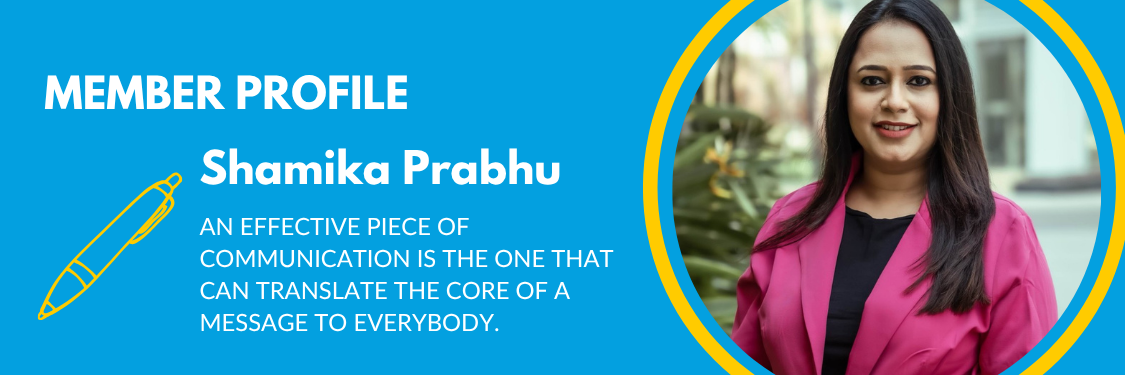
I didn’t quite catch her point. Then she said something that truly changed the way I saw communications – Communication is not about flaunting high-level English. An effective piece of communication is the one that can translate the core of a message to everybody: be they a senior leader or a warehouse worker. Using complex sentences doesn’t make for a superior draft. Easy to understand and simpler sentences help avoid all sorts of ambiguity in any communication. A true comms professional doesn’t focus on flaunting their language skills, but generates a draft that is understood by all in the tone that’s intended.
This was very simple advice, but I still hold it close. It has helped me become a Comms professional who is able to understand, interpret and translate the messages effectively.
If you could add a superpower to your team, what would it be, and why?
I think if I could add a superpower in my team or if it was something I could have myself, that would be the ability to read people’s mind beyond their choice of words.
I’ve often seen clients and sometimes even leaders say something, but not exactly mean it, while briefing the comms teams. After years of fighting for a seat at the table, many communications professionals finally get there only to realise that when critical business conversations begin, they are often expected to use the organisation’s PR engine to build individual leaders’ personal brands rather than advance genuine business priorities.
What makes it even more interesting is that this need is rarely articulated openly. It is often framed under the larger umbrella of “strengthening the corporate brand”, while the underlying expectation is to elevate leadership visibility and reputation. Many leaders are not vocal about this intention, which is why I sometimes feel that if I could have one superpower, it would be the ability to read minds to understand what leaders are actually thinking versus what they are saying.
What do you think is the biggest challenge facing the comms profession today?
I think the biggest challenge faced by the comms professional today is that organisations are still viewing communications as a reactive strategy rather than a proactive tactic. In various industries, communication teams are pulled in only when there is a launch, announcement or some negative PR or policy rollouts.
I see comms teams building their annual strategies for the upcoming years, but other than the comms team no one seems to care. It is an unfortunate truth, but a lot of Corp Comm teams are working just to stay afloat. We as comms professionals need to move from being survivors to becoming navigators.
Comms is still climbing high and, as professionals, we need to believe in the elevation of this industry and collectively work towards it.
What's your best AI hack?
Funnily, comms and writing professionals were the first set of people who thought (or maybe still think) that AI will take away their jobs. That’s neither 100% true or false. AI-written drafts cannot be used without human intervention, especially in external communications, as it has very high chance of getting picked by AI detectors and could lead into copyright issues. Also, these days, people can read and tell if something is written by AI. So, my best hack would be to write down the material yourself (without getting influenced by any other draft) and then use AI to polish certain parts of the draft. But never blindly follow AI. Nothing can replace a human’s relevance and sensitivity.
How does an IABC NSW membership benefit your career?
For me this membership is the best way to stay connected with your peers. I always look forward to the meet ups – they act like a playground to exchange ideas and different kinds of approaches towards comms related issues.
Shamika is a communications professional with 10+ years’ experience shaping corporate reputation, driving integrated campaigns and supporting senior leadership across complex and regulated environments. Her career spans agency and in-house roles across healthcare, FMCG, lifestyle, logistics and technology — giving her both strategic depth and executional agility. She specialises in translating complex business priorities into clear, compelling narratives that build trust, influence stakeholders and deliver measurable impact.