

Culture, leadership and comms expert Shane Hatton shares six things to consider when designing your internal comms strategy.
Nigel Richards is widely considered the greatest Scrabble player of all time. A few years ago, he won the French-language world championship after spending nine weeks memorising the French dictionary. He then needed a translator at the press conference, because he didn't speak a word of French.
This describes a common experience that many organisations face with their culture and organisational values, says Shane Hatton, a culture, leadership and communication expert.
"There's a big difference between knowing the words and speaking the language," says Hatton. Speaking at an IABC NSW event in Sydney last month.
Closing that gap, he says, is where the comms professional's value really shines.
Here are six of the top ideas Hatton shared that can help you design an effective internal comms strategies that will get cut through with your workforce.
1. Culture already exists. You're shaping it, not building it
Teams don't wait for a strategy before they have a culture.
"It's not something that you create. It's something that you shape," says Hatton. "It already exists, whether it's by choice or chance, default or by design."
2. Employees are checking your messages against reality
New starters and long-timers alike are working out what's really valued, and they do it by watching.
"They're looking at your policies, onboarding, your comms. They're looking at what the CEO says. They're looking at what their team leader says," says Hatton.
They use everything they can see to make sense of what they can't. Then comes the test.
"Our leader says this, but they did this," says Hatton. "Internal comms is painting this beautiful picture, but what's happening down the hall is a very different reality."
Employees use that gap to decide how to behave and where they fit. If your channels say one thing and the floor says another, the floor wins.
Try this: Before a values or culture campaign goes out, run the draft past a handful of frontline managers and ask, "Does this match what your team sees on a normal week?" If the answer is no, fix the reality or soften the message. Don't send the glossy version anyway and hope for the best.
3. Aim for shared understanding, not a perfect definition
In Hatton's research with 1,000 Australian frontline managers, 99 per cent said culture was critical and almost all said they could define it. Their definitions sounded suspiciously like the top Google result.
"It's not as important to have a shared definition as it is to have a shared understanding," says Hatton.
Hatton likens it to the story of three blindfolded people feeling an elephant. One holds the trunk and says it's a snake, one holds a leg and says it's a tree, and one holds an ear and says it's a fan. Everyone is touching a real part of the animal, and no one has the whole picture.
Organisations do the same with their values.
"We say we're a very flexible culture, which means something different to IT, to HR and to frontline staff," says Hatton. "Everyone's holding onto a different piece of that elephant."
The fix is to turn abstract culture ideas into everyday behaviour, he says.
"Great communication isn't just an exchange of words. It's a transfer of meaning," says Hatton.
Try this: Ask people in three different functions to explain one of your values in their own words, then lay the answers side by side. Wherever they differ, you've found a message that needs work.
4. Build language and memes, not corporate jargon
Only about a third of Hatton's research respondents (32 per cent) said shared organisational language shapes culture, which he sees as a missed opportunity.
His answer is the meme, and he's quick to say he doesn't mean the internet kind. The word comes from biologist Richard Dawkins' work on how ideas spread from person to person, much as genes do.
"Memes are an incredibly powerful way to bring culture to life," says Hatton.
His test for a phrase that sticks is that it's both meaningful and memorable.
"They need to be personally meaningful to the people you're leading," he says, "and memorable enough that they spread and get shared."
Hatton plots this as a quadrant, and most workplaces land in one of three weaker boxes:
Neither meaningful nor memorable. Ask what the culture is like and everyone gives a different answer. Or they point to the values, and "it doesn't really mean anything to anybody".
Meaningful but not memorable. The idea matters, but no one can repeat it, so it never spreads.
Memorable but not meaningful. This is the cliché: catchy, easy to recall and empty. These are the slogans, "typically posters on walls".
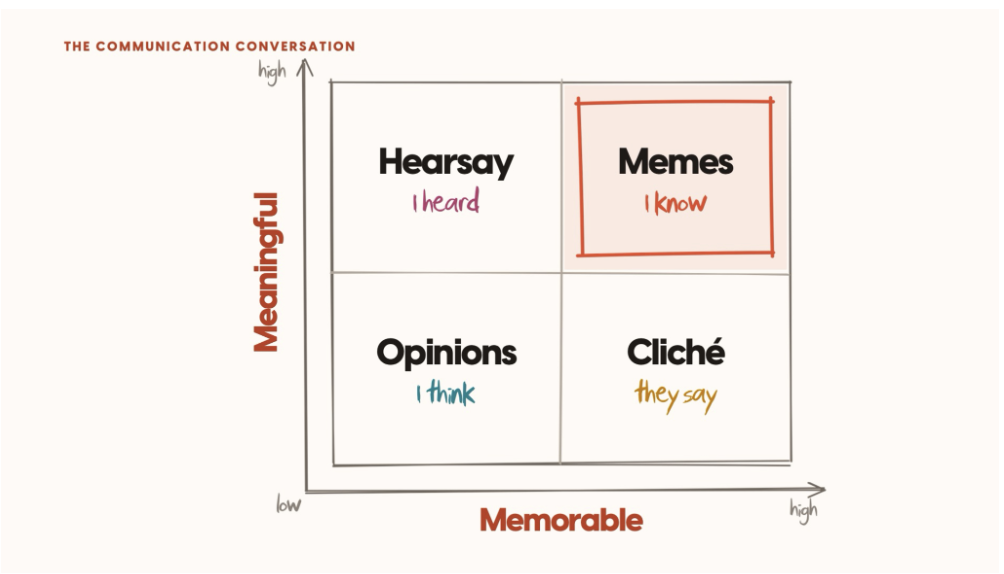
A true meme sits in the fourth box. Employees can say it, explain it and see themselves in it.
"Memes become the language that we speak."
Try this: List the phrases in your current campaigns and score each out of five for meaning and memorability, ideally with a few employees doing the scoring.
Anything that scores high on only one measure goes back to the drawing board. Then listen for whether managers use any of the phrases unprompted, in meetings, chat channels and hallway conversations. If they don't, it's a slogan.
5. Pick the kind of meme you need
Hatton sorts culture memes into four types.
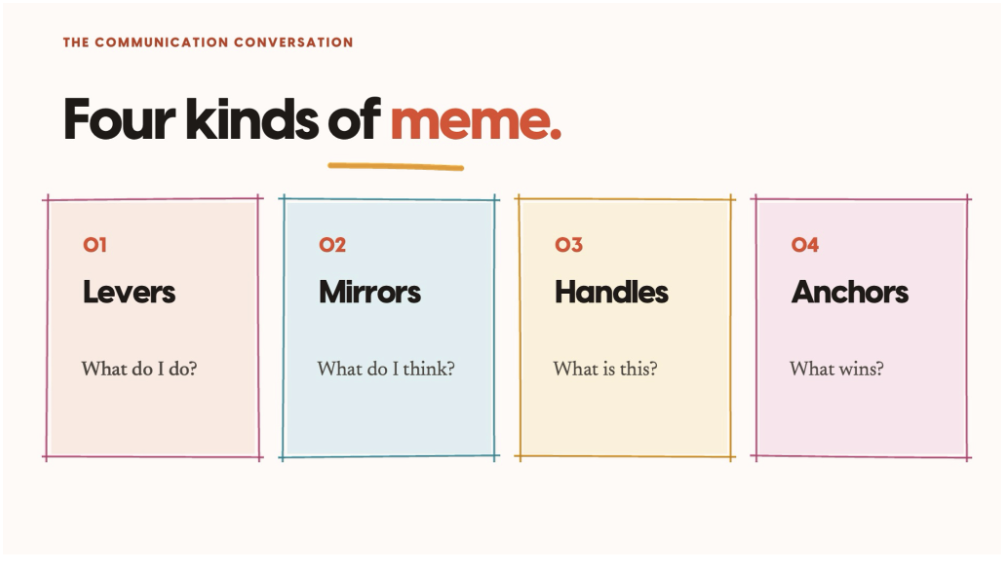
Levers tell people what to do. Toyota's 'pull the andon' lets anyone halt the line over a safety concern. These words outranked the manager's directions, he says.
Mirrors prompt reflection. Netflix asks, "Would I fight to keep this person?"
Handles are phrases people can pick up and carry. Queensland Health's Ryan's Rule lets families call for an urgent clinical review when they think a patient is getting worse.
Anchors help people choose between options. A Victorian public sector team Hatton worked with used the phrase 'Are we playing orchestral or jazz' to signal whether to follow the plan or improvise.
Try this: Collect the phrases people already use to explain how things work here. Ask managers, scan chat channels and listen in meetings. Then sort them into levers, mirrors, handles and anchors. The empty category shows what's missing. If you have plenty of slogans but no levers, for example, people may know what you value but not what to do about it.
6. Mine your stories for the memes inside them
Storytelling is a comms strength, and Hatton says it's critical for culture to flourish.
He shared a story from Anne Bennett about her father, a teenage swimmer who knew he'd missed the wall in a backstroke final. Even though he likely could have got away with it, he went back and touched the wall, losing his shot at a spot in the Olympics due to those few seconds he added to this time.
This story then morphed into cultural language in Bennett's company.
"If they say, 'Our values are integrity, is this an integrity moment?', that's a poster," says Hatton. "If they say, 'I reckon this might be our touch-the-wall moment,' and everyone goes, 'Yeah,' it's both meaningful and memorable."
Try this: Harvest and mine for the memes that exist within your stories.
"In the orchestra of culture, communication professionals are the composers," he says. "You can write the sheet music teams play from. Please do not undervalue your role in shaping culture."
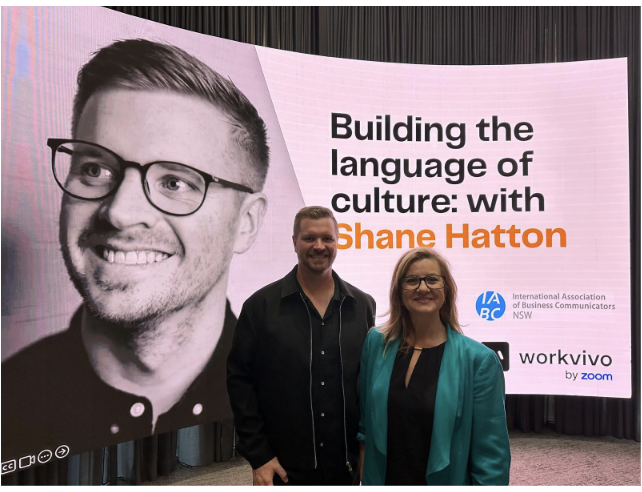
Image: Shane Hatton and Pia Broadley, Head of Sales APJ, Workvivo by Zoom.
To learn more about Shane and his work, you can visit his website here, or follow him on LinkedIn here. Thanks to Workvivo by Zoom for partnering with us on this event.