
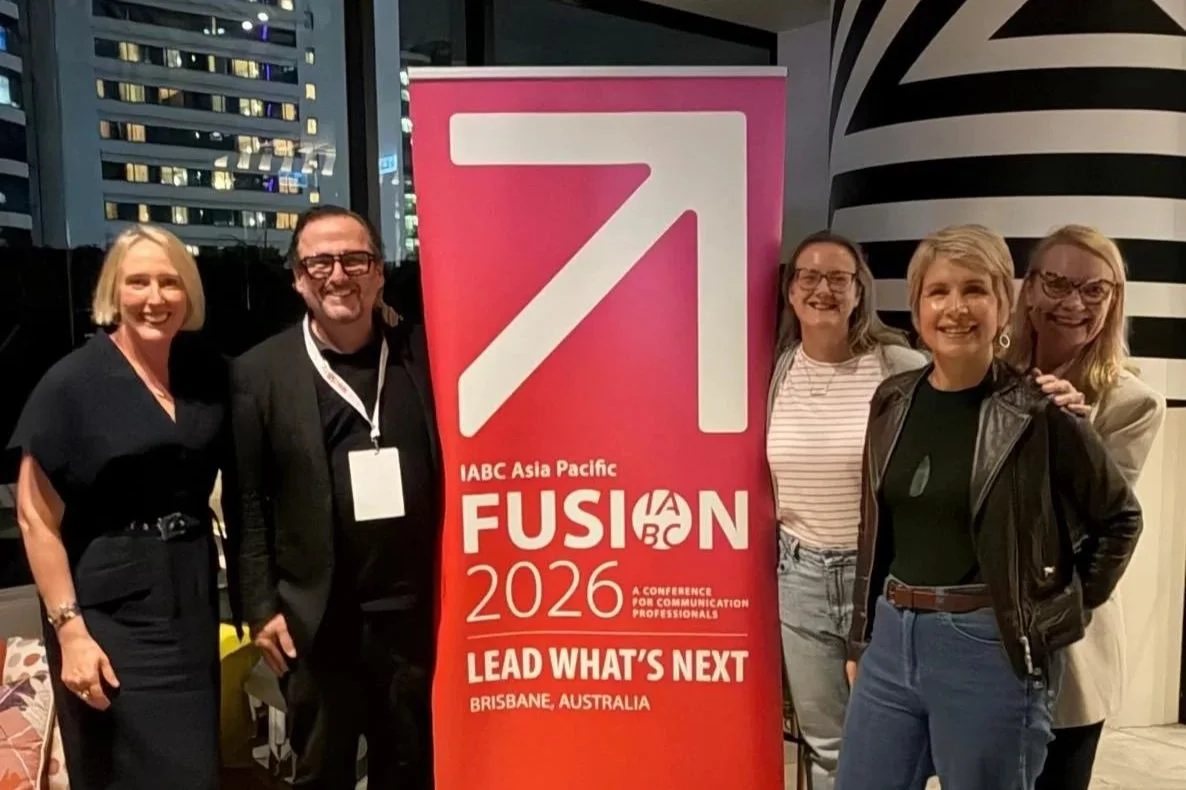
Board members past and present. L-R Helen Pennock, Patrick Armstrong, Lucy Hose, Rhys Kelly and Jane Hamilton
Our Co-Vice President Lucy Hose has pulled together some of the themes that stayed with us, and what you can do about putting them into practice.
I came home from IABC Asia Pacific Fusion 2026 in Brisbane with 33 pages of handwritten notes. Clearly, there was plenty I wanted to remember.
Looking back through them, I kept returning to a question: when producing content becomes easier, where should communicators put more of our attention?
Against a backdrop of mistrust, misinformation and AI, the threads that stayed with me were very human: understanding context, asking better questions, making space for honest conversations and helping people make decisions.
My reflections from the sessions I attended are focused on ideas I want to do something with now I’m out of the Fusion bubble and back at my desk.
From producing communication to shaping decisions
A recurring theme was the difference between delivering an output and helping achieve an outcome. It sounds familiar, right? Putting it into practice, especially when the requests keep coming, is another matter.
Full disclosure: AI has helped me pull this piece together, organising my handwritten notes and thoughts into themes. But deciding what resonated, questioning the interpretation and checking that it reflects what I actually took away? Spoiler alert: that still needed me!
That feels relevant to our role more broadly. Producing something is not the same as knowing whether it is the right thing to produce. Before discussing the channel or drafting the message, we need to understand the problem, the people involved and the decision or change we’re supporting.
Shea Evans’ session on facilitation gave me a practical way to think about that shift from order-taker to strategic partner. Start with the outcome and prepare for the people, not just the content:
Who will be in the room?
Whose perspective might we miss?
What are we actually asking people to decide?
One reminder I particularly liked: a good conversation isn’t the outcome on its own. It needs to lead somewhere – with clarity about what happens next. For me, as a communications professional and trusted adviser, that means getting involved earlier and helping turn discussion into decisions, rather than simply documenting what was said.
AI needs context, not just content
One of the strongest threads I took away was the value of context. AI can help with the words. We still need to understand what sits behind them.
Peter Zink’s session made me think; what has happened before? What are employees hearing, and what are they making of it? Where is there a gap between leadership’s intention and people’s experience? A polished draft won’t answer those questions for us.
My practical takeaway is to capture more of that context, not just collect more content: the questions stakeholders ask, the concerns behind their feedback and the language that makes sense to them. That can improve both the advice we give and the way we use AI.
For me, the human role is not just checking the spelling at the end. It’s applying judgement, challenging assumptions and taking responsibility for what we put out.
That also means being willing to challenge an answer that sounds convincing, whether it comes from a tool or a conversation. Does it fit what we know? What’s missing? Who else should we ask?
Serious messages can still be human
Stephen Harvey’s session on using humour in safety and risk communication particularly resonated with me. Safety is serious. That doesn’t mean every message has to sound solemn.
This session left me with practical ideas about stories, metaphors and analogies, alongside a distinction that matters: laugh with people, not at them. The point wasn’t to turn every communicator into a comedian. It was to think harder about how we connect.
Which brings me to another thread: clarity and relevance matter, but so does how a message makes someone feel. That made me wonder whether we’re sometimes in danger of stripping out the human angle that could help a message land with our audience.
My action from Stephen’s session: look beyond the statement of facts. Would a story help someone understand why this matters? Would an analogy make something complex clearer? Is humour appropriate for this audience and situation, or would it get in the way?
The test is still what the communication helps people understand or do, not whether we’ve entertained them or ticked off another message.
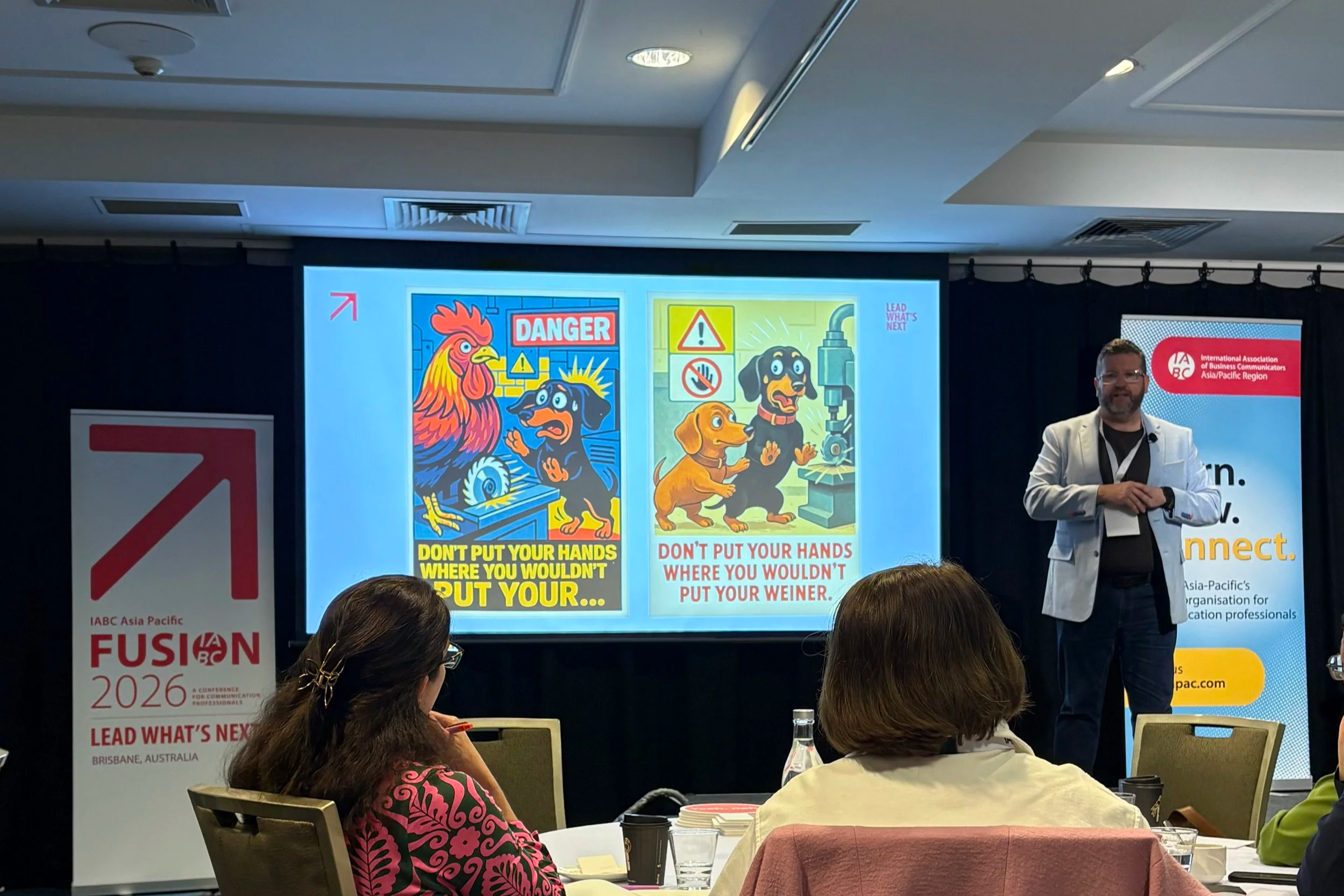
Stephen Harvey on stage at Fusion - bringing the fun to safety messages
Trust remains our currency
Trust kept coming up throughout Fusion in discussions on AI, leadership and change. I mean, how could it not?! But the most useful question for me wasn’t how to write a more trustworthy message. It was whether the message matches people’s experience.
The gap between what an organisation says and what it does appeared repeatedly in my notes. We can’t write our way around that gap. We can help make it visible, ask difficult questions and bring what people are telling us into the discussion before a decision is announced.
That takes more than asking whether everyone agrees. A nod isn’t necessarily agreement, and silence isn’t proof of alignment. Whose voice haven’t we heard? What trade-offs are we making? Who is responsible for what happens next?
In a climate of mistrust, I see part of our role as helping organisations be worthy of trust, not just asking people to trust them. That means honest conversations, evidence behind our advice and a willingness to surface uncomfortable gaps.
What I’ve taken back to my desk
I left Fusion energised about our profession, but also reminded that influence comes with responsibility. Being a strategic partner means contributing our judgement, not simply waiting for a strategic brief.
My notes prompted a useful challenge: are we demonstrating our activity, or the value of our contribution?
For me, that translates into a few practical habits: start with the outcome, get closer to the conversations that provide context, make space for challenge and agree how we’ll know whether the work has helped. Then follow through on the decisions, not just the messages.
None of that means abandoning good writing or our communications craft. It means connecting them to a clear purpose and being more deliberate about where our expertise can make the greatest difference.
If I had to distil those 33 pages into one question to keep asking, it would be this.
Not just “What do we need to communicate?”
But:
“What are we trying to change, and what role can communication play in making that happen?”
In my role, as in many communicators’ roles, we are often trying to change behaviour or encourage someone to act. We need to play a bigger role in shaping how we do this, and get involved earlier, especially during a crisis and in the current climate of mistrust and misinformation.
Thank you to IABC Asia Pacific, IABC Queensland, the speakers, volunteers and everyone involved in bringing the communication community together in Brisbane on 19 and 20 October. Professional development, time to connect and conversations that continue beyond the sessions – the perfect IABC cocktail mix!