
Embrace belonging communications in a world of never-ending change

Small, strategic changes to the way you communicate can play a powerful role in preventing organisational apathy.
Note: This is a summary of a session held at the APAC 2025 IABC Fusion conference in Manilla. Join us for Fusion 2026, this year held in Brisbane.
By Kate Neilson
Despite the pandemic being an incredibly de-stabilising time for most businesses, it was also an environment ripe for innovation. Amid the chaos, a new era of agile collaboration between leadership and employees emerged.
With no established playbook, leaders and employees were, for once, on level ground. Everyone was navigating the same uncertainty – together. This created a brief but powerful shift in workplace dynamics. Leaders sought ideas from the ground up on how to work, connect and learn in entirely new ways. And while the process was often scrappy, it was also deeply collaborative. Employees weren’t just being heard – their ideas were acted upon quickly.
This collective effort gave rise to a renewed sense of purpose and ownership. For a moment, employees felt like key contributors to organisational growth, not just executors of a top-down strategy.
Then came November 2022.
The arrival of ChatGPT marked a turning point. AI quickly took centre stage in strategic conversations. Faced with rising costs and intensifying competition, many business leaders began to shift their focus – from employee-led innovation to AI-driven efficiency.
“At a time when leaders desperately needed innovative, growth-fuelling ideas to propel their businesses forward, a sense of organisational apathy is brewing among the workforce.”
Whether deliberate or not, the message that filtered through was stark: AI had become the new growth lever. And employees? No longer the most effective or economical option.
Add to this the recent backflip some employers have made regarding their sentiment about remote working arrangements – which were once hailed as the future of work during the pandemic era – and a predictable fallout has emerged.
Employees’ discretionary effort – which surged during the pandemic – began to wane. Disengagement crept in and the so-called 'quiet quitting' trend proliferated.
As all of this was happening, a few concerning challenges began to emerge. Firstly, the technology wasn't yet at a stage to deliver on the growth goals CEOs had set (some would argue that it still isn't).
In fact, according to Gartner predictions, AI was about to enter what it calls the 'trough of disillusionment'. It was delivering efficiency gains here and there, but was it able to move the needle on the kind of growth CEOs wanted to see – expansion into new markets or development of new products? Not quite.
These friction points weren’t just isolated to leaders' communication approach. They were also impacted by the broader organisational change agenda.
Gartner found that as the amount of change employees experienced in their organisations increased, their willingness to embrace change decreased (see chart below), creating less-than-ideal circumstances for innovation to occur.
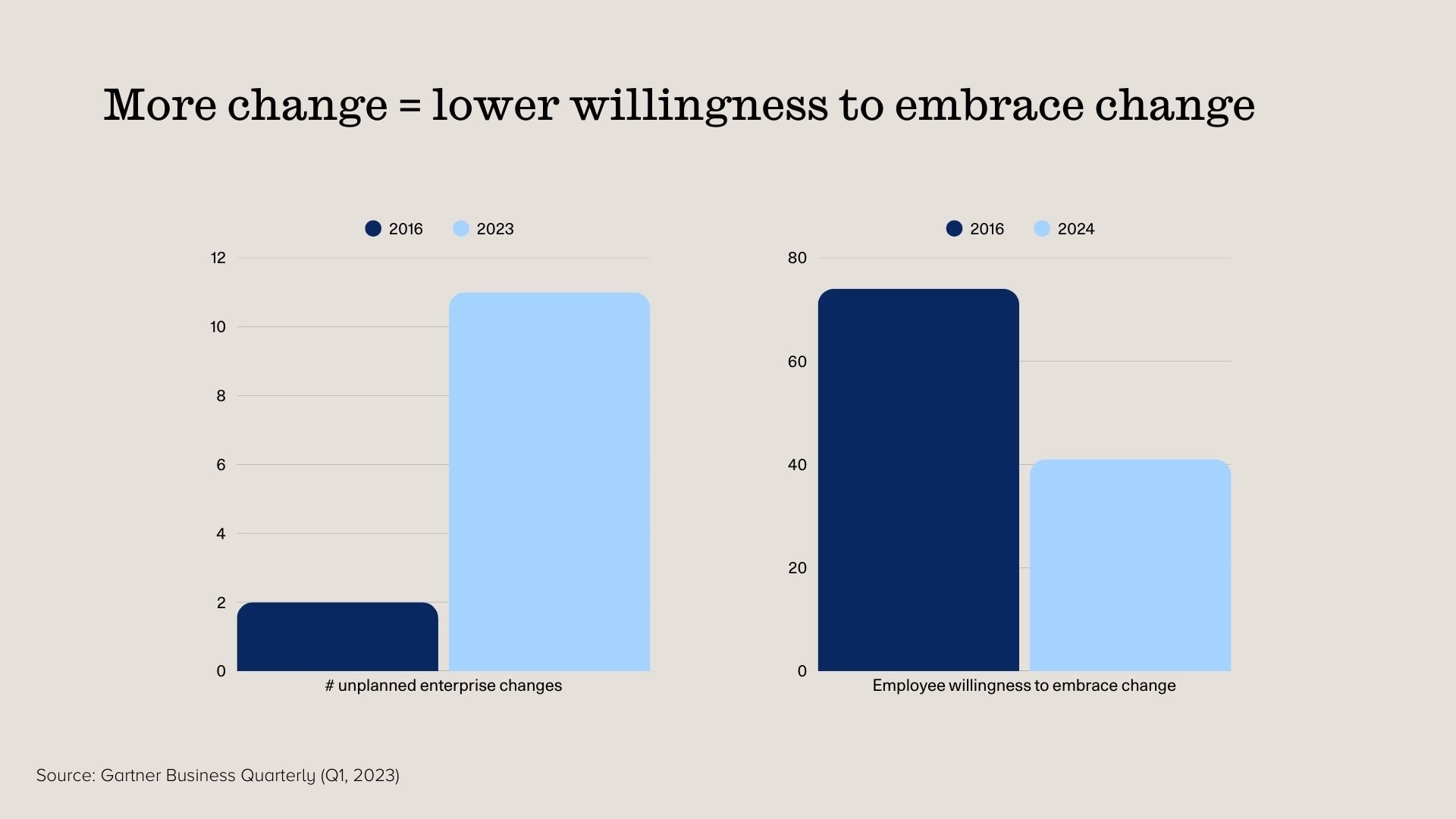
All of this is to say that, at a time when leaders desperately needed innovative, growth-fuelling ideas to propel their businesses forward, a sense of organisational apathy is brewing among the workforce.
Belonging comms as an antidote to organisational apathy
While the pandemic/AI example is defined by a specific moment in time, the risk of organisational apathy continues. Flexible work debates remain; cost-of-living challenges continue to outstrip wages; and trust in leadership is increasingly fragile, making it harder for organisations to mobilise their people around change.
So what can we do to remedy this? One solution lies in applying a 'belonging communications' layer to change messaging from leadership.
Where traditional, business-centric communications tend to focus on telling employees what they must do – often in the context of compliance, performance or policy – belonging communications places the stakeholder (in this example, employees) at the centre of the message.
Rather than being purely directive, the message is framed to show how employees are part of something bigger, helping them understand the 'why' behind the change and how their role contributes to shared goals.
Take, for example, the rollout of mandatory training. A traditional message might say: “Completion of this training is required by Friday. Failure to complete it may impact your performance review.” This framing assumes resistance and prioritises control.
In contrast, a belonging-focused message might say: “We’re rolling out a new way of working in the coming months. Would you like to learn more about how it could benefit you? Would you like to pilot it and give us some feedback?
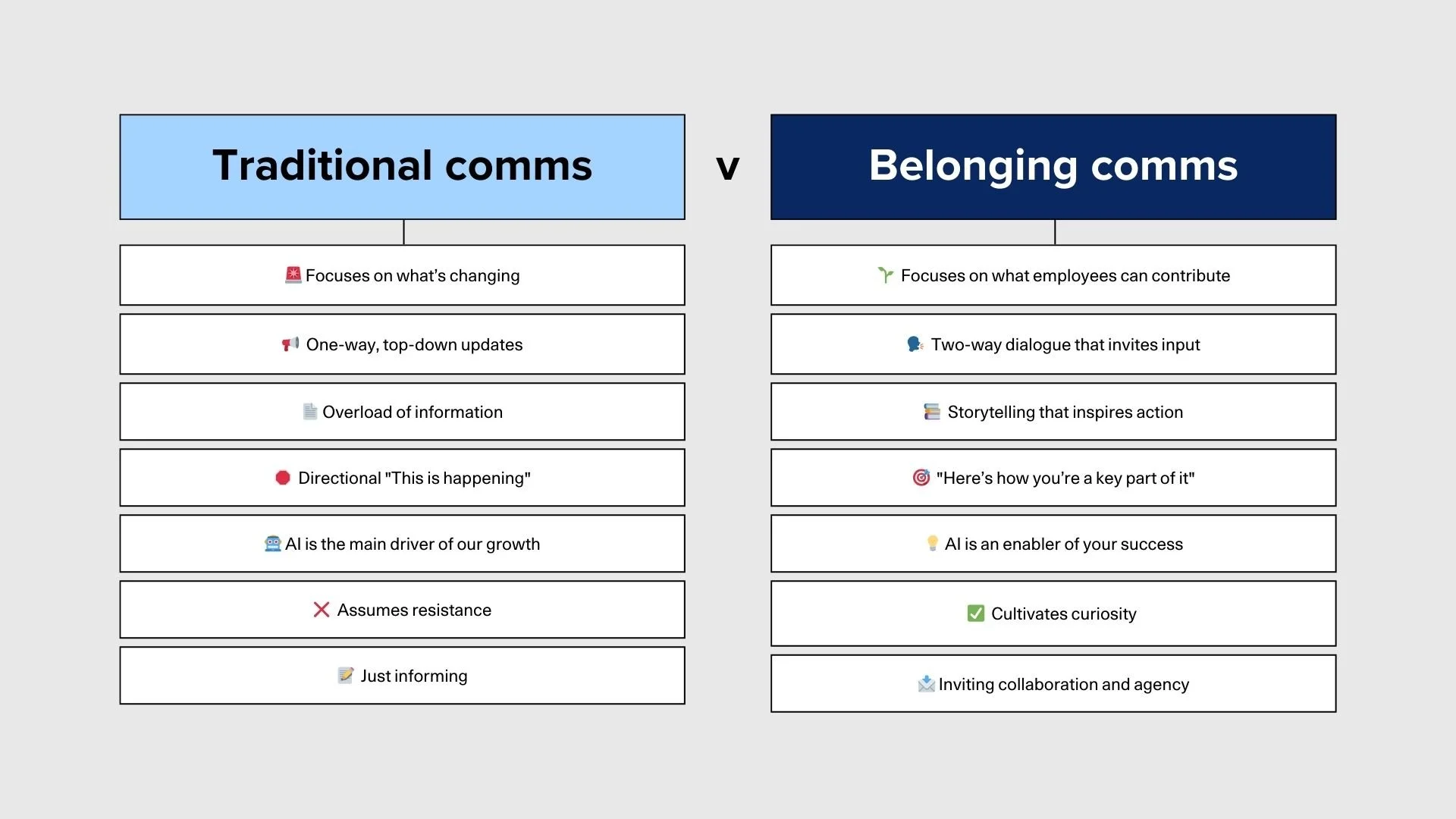
The goal isn’t to relinquish control or delegate decision-making to employees. It’s to take a more human-centric path to the same destination. By inviting curiosity and fostering psychological safety, leaders are more likely to secure buy-in and meaningful engagement with the initiative they've likely spent a lot of time and money on.
The power of authentic, jargon-free messaging
For belonging communications to be effective, a few key elements need to be in place. First and foremost: authenticity. Get this wrong, and you risk accelerating organisational apathy levels.
Start with dropping the jargon. Employees shouldn't have to decode your messaging. If they find themselves rolling their eyes at another layer of business-speak, you've lost them.
One of the quickest ways to undermine trust is to communicate in a way that feels insincere or patronising. Employees can spot inauthenticity a mile away – so speak plainly, and speak in their language.
For example, instead of saying: “We’re restructuring our business units to improve efficiency and respond to external market conditions.”
Try saying something like: “We’re making some changes to create clearer career pathways for you and to reduce workload bottlenecks.”
Part of treating employees like adults is resisting the urge to sugar-coat difficult news – a common pitfall in corporate messaging. Compassion and clarity can coexist. Be honest about what’s changing, what hasn’t worked and where extra effort will be needed. Respecting your audience means trusting them with the truth.
I’m reminded of an employer branding expert I once interviewed. When I asked what makes a job ad stand out, he said: “I always add a line that reads: ‘Here’s why you might not like working here,’” and then listed the unique or challenging aspects of the role.
That level of transparency is rare in business communications, but it’s a hallmark of belonging communications. It builds credibility, fosters trust and sets your organisation apart.
What's in it for us?
Next, make sure your messaging is anchored in relevance. That means clearly articulating the what, the why and, most importantly, the so what?
Most organisations are already good at communicating the what – for example: “We’re rolling out an AI training program.” Many also cover the why: “We’re doing this because we’ve identified AI as a critical skill to stay competitive.”
But fewer take the final, crucial step – answering the so what? That’s the part employees care about most: “How will this impact me, for better or worse?”
Here’s how that might look in practice:
What: “We’re restructuring teams to improve efficiency.”
Why: “This restructure means clearer roles and career pathways, with less duplication of work.”
So what?: “You’ll have more time for meaningful work and fewer frustrations navigating unclear processes.”
The so what? messaging may seem obvious, but it’s often the missing link. People need to hear information multiple times – and sometimes from different angles/people – before it really lands. Encouraging leaders to go a few layers deeper in their communication not only builds clarity, it builds trust. And that pays dividends.
Finally, consider how you can bake stability into your language. Highlighting what isn’t changing is just as important as updating employees on what is. Reminding people of these stability points acts like a buoy in choppy waters – it's something they can anchor to.
When stability is paired with messaging that is authentic, transparent and inclusive, it provides a sense of reassurance that builds trust and helps your workforce to feel like you're all working in service of the same goals.
This is a summary of a session held at the APAC 2025 IABC Fusion conference in Manilla. Join us for Fusion 2026, this year held in Brisbane.